The Best Cities in Illinois to Start a Laundry Business (2026)
Illinois gives a home laundry pro a friendly starting position anywhere in the state — no sales tax on laundry services, one state portal for your paperwork — and three very different markets to choose from. But here’s the part rankings usually miss — you don’t need a whole city. You need one dense patch of one. Twenty to thirty repeat households on a tight route is a full book for a home pro, and every city on this list contains hundreds of patches like that. Here’s how Chicago, Aurora, and Joliet stack up, what makes each one work, and how to pick your patch. For the statewide paperwork and cost picture, see our Illinois state hub for laundry pros.
Disclaimer: general information, not legal advice. Confirm your specifics on the official state and local sites linked below.
Chicago — density nothing else in Illinois comes close to
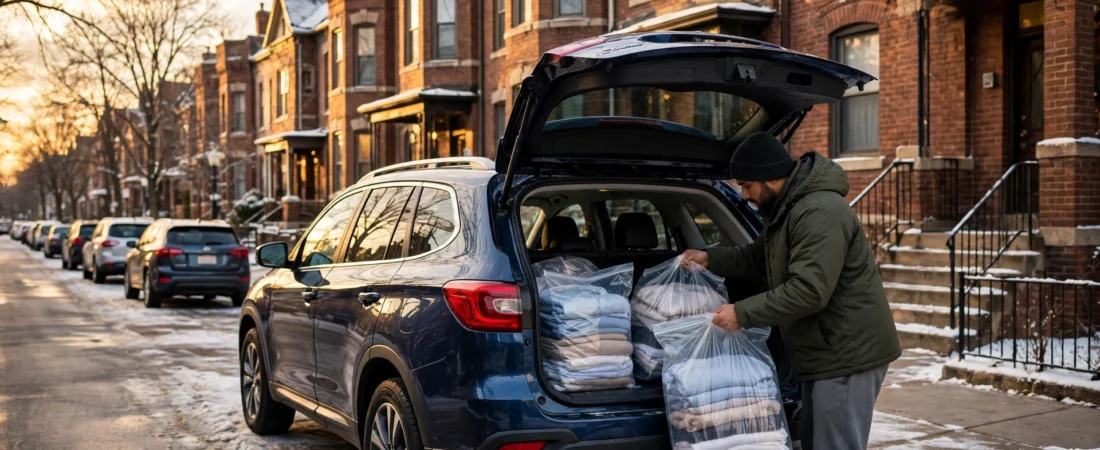
Population: 2,746,388 (2020 Census) — the largest city in Illinois and the third-largest in the United States. Chicago’s advantage is how those millions live: in apartments. Huge numbers of city households have small in-unit machines, shared laundry rooms they don’t love, or no machines at all — in buildings where one stop can mean a hallway of potential regulars. A single dense block can hold more households than a downstate suburb, and a route can fill without ever crossing town. Winters do quiet marketing for you, too: when the laundromat run means a cold, bundled errand, a pro who collects from the door becomes very easy to keep. The winning pattern is the opposite of the city’s size: pick one patch — a cluster of buildings you can serve on foot or in a short drive — and own it street by street. The full launch path is in our Chicago laundry business guide.
Aurora — the family-suburb market
Population: 180,542 (2020 Census) — Illinois’ second-largest city, and a different shape from Chicago entirely. Aurora’s map is family suburbs: street after street of houses full of two-income households, kids, and weeknight schedules with no slack in them — the exact households that hand off wash day first. The route pattern here is the subdivision cluster: group your regulars by neighborhood, run one side of the city per day, and keep drives between stops short. Demand is the steady kind rather than the seasonal kind — the same households needing the same weekly help in every month of the year. Start with one cluster, build your regulars street by street, and let referrals do the expanding. The city-specific launch steps are in our Aurora laundry business guide.
Joliet — value housing and room to be first
Population: 150,362 (2020 Census). Joliet pairs family neighborhoods with housing costs that stay comparatively reasonable — which matters twice over: it keeps a home-based pro’s own overhead low, and it leaves households room in the budget for a service that buys back their evenings. The city is compact enough that routes stay short, and the family neighborhoods around it widen the patch without lengthening the drive much. Smaller than Chicago and Aurora also means thinner competition: in many patches, the first pro to show up reliably, week after week, becomes the default name households pass to each other. Start with one neighborhood cluster and build from your own door outward. The local playbook: Joliet laundry business guide.
What you can charge, anywhere in Illinois
Pricing works the same in all three cities: wash and fold is charged per pound, and typical prices commonly run about $1.50–$2.50 per pound with pickup and delivery (a typical range, not a statistic for any one city — check the laundromats near your patch and land in that band). One Illinois bonus applies everywhere in the state: under the Department of Revenue’s rule, your service charges carry no sales tax — Illinois does not tax sales of service — so the price you quote is the price on the order, with no tax line on the service. The earning math works the same in all three cities. An honest illustration, not a promise: one 20-pound order at $2.00/lb is $40, so five regular households ordering weekly is about $800/month, and fifteen regulars is roughly $2,400/month. Plug in your own price, pounds, and regulars on our income calculator — the city matters less than the route.
How to pick your city — and your patch inside it
- Density beats raw size. A full route inside one Chicago building cluster or one Aurora subdivision beats scattered orders across a whole metro. Rank your options by how many households you can reach in a 15-minute drive, not by city population.
- Look for apartment clusters and family neighborhoods. Renters without good in-unit machines and busy two-income households are the two most reliable customer shapes in every Illinois city.
- Start where you live. Your first route should begin at your own door — your neighbors are your first reviews, your first referrals, and your shortest drives.
- Your state paperwork travels with you. Illinois structure filings are state-level — an LLC is formed with the Secretary of State, and the state’s one-stop for starting out is Illinois DCEO Small Business Assistance — so expanding from one city to the next later is route planning plus a county name filing and local checks, not a new business. The no-service-tax rule follows you anywhere in Illinois too.
One page for whichever city you pick
Whichever patch you choose, the booking setup is the same — and it matters more than the city. Gig apps bring orders and keep a percentage of every one, permanently. Owning your page flips that. LaundryCareer gives Illinois pros their own branded booking page with online booking, card payments, and pickup scheduling for free — nothing is charged when you sign up — you get paid on every order — you pick Plus ($8/month plus 4% when you get paid) or Unlimited ($20/month with 0%) when you activate (Stripe’s standard card fee still applies). Your page carries your name and your city — your customers book with you, and the regulars you earn stay yours if you expand to a second city later.
Quick answers for Illinois pros
Which Illinois city is best overall? The one where you can build the densest route. Chicago has the most households per stop, Aurora the classic family-suburb map, and Joliet value housing with thinner competition. A full route in any of them beats a scattered presence in the “best” one.
Do I need to live in one of these three cities? No. The model is route-based and the state rules are the same everywhere in Illinois; smaller cities and suburbs work with tighter routes and the same per-pound pricing. These three are simply where the most households are.
Does winter really change the business in Chicago? Yes — in your favor. Cold makes the laundromat trip the first errand households want to hand off, so winter is when pickup-and-delivery regulars are easiest to win, and the habit carries into the rest of the year.
The Illinois city-pick checklist
- ☐ Map the households within a 15-minute drive of your door
- ☐ Count apartment clusters and family neighborhoods in that patch
- ☐ Check typical per-pound prices at laundromats near your patch ($1.50–$2.50/lb is the common band)
- ☐ Read the city guide for your city (Chicago, Aurora, or Joliet — all linked above)
- ☐ Register an assumed name with your county clerk if using a business name
- ☐ Launch your booking page and share the link with your first 10 households
Every city on this list can fill a home pro’s book — the winner is the patch you can serve reliably, week after week. Pick yours: see the full Illinois startup guide or create your pro account and launch your Illinois booking page.