How Much Does It Cost to Start a Laundry Business in South Dakota? (2026)
South Dakota keeps the launch cheap, with one rule to respect from day one: laundry services are taxed here. A home laundry pro registers with the state before her first order, collects the tax on each order, and remits it — a routine, not a fee. Beyond it: a free EIN, a trade name for a business name, and an LLC — if you want one — at $150 online, or $165 by paper. If you already own a washer and dryer, the real launch costs are a starter kit and, when you’re ready, that LLC and an insurance policy. This post walks every line item, then adds it up two ways. Our companion post walks the rules side in full: South Dakota rules for a home laundry business.
Disclaimer: general information, not legal advice. Confirm your specifics on the official state sites linked below.
Step 1: The South Dakota paperwork — one tax registration before anything else
Sales tax on your service: collected on every order. SD Admin. Rule 64:06:02:16 states it plainly: “Gross receipts from cleaning and pressing, dry cleaning, and laundry services are subject to sales tax,” and SDCL 10-45-5 likewise taxes “laundry; linen and towel supply” receipts. A home pro who picks up, washes, folds, and delivers is providing a laundry service, so the setup is: register with the state before your first order, collect the sales tax from the customer on each order — on top of your price — and remit what you collected. The tax is the customer’s money passing through your hands — never your income. One different case does not reach you: coin-operated machines are handled differently — they pay an annual per-machine license fee instead, under SDCL 10-45-5.1 — but a pickup-and-delivery pro is not a coin-op machine. The supplies you buy — detergent, bags, labels — are ordinary purchases, taxed at the register like anyone’s shopping.
EIN: $0. A federal employer identification number is free from the IRS and takes about 10 minutes. It keeps your Social Security number off forms, and a separate business account keeps your money records clean from day one.
Trade name: register one as part of your state business setup if you use a business name. Doing business under a name that isn’t your own legal name? Register a trade name as part of your state business setup, before the name goes on bags, cards, or a booking page. Operating under your own legal name? This step may not apply at all.
LLC: $150 filed online — and it can wait. A South Dakota LLC separates the business from you personally. The filing fee is $150 filed online (Articles of Organization, filed with the Secretary of State); the same filing by paper costs $165, including a $15 paper-processing fee. It is not required before your first order: many pros start as sole proprietors with a trade name and form the LLC once weekly revenue is steady. Start business filings at the official portal: Secretary of State SOS Enterprise (sosenterprise.sd.gov) — “Form or Register a New Business”.
Step 2: The starter kit — your only real shopping list
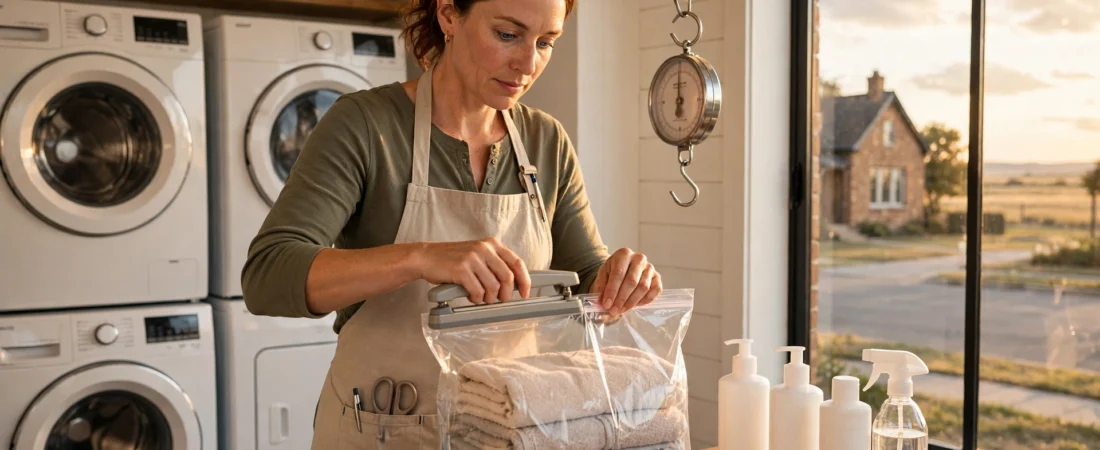
Your washer and dryer: $0 if you use the ones you own. A home pro’s starter kit is small: a hanging scale (you’ll price by the pound), clear bags so customers get their laundry back in clean, sealed loads, labels or tags, detergent options including an unscented one, and a dedicated folding surface. A typical starter kit runs about $150–$300 — a ballpark for supplies, not a South Dakota statistic. Our general wash and fold startup costs breakdown goes deeper.
Step 3: Insurance — the one cost not to skip
A general liability policy typically runs $300–$600/year for a small home service business. It turns a damaged garment or a spill in a customer’s home from a personal bill into an insurance claim. Budget for it in your first season — plenty of pros add it with their first regulars.
Step 4: The second-machine question — your biggest cost can wait
The one purchase that tempts every new pro is a second washer and dryer. Resist it at launch. A second set is the right buy when your route is full and turnaround is what turns customers away; by then your orders pay for it. Start with the set you own and learn your real pounds-per-week first.
Two example budgets, with the math shown
Bare-bones start (sole proprietor, machines you own, lean starter kit):
- EIN: $0
- Starter supplies: $150
- Total: $0 + $150 = $150
One more step sits outside that total if you operate under a business name: registering the trade name — no verified fee exists for it, so no price is put on it here.
Set-up-properly start (the same start, done completely from day one):
- EIN: $0
- LLC (Articles of Organization, filed online with the Secretary of State): $150
- General liability insurance (middle of the typical $300–$600 range): $450
- Fuller starter kit: $300
- Total: $0 + $150 + $450 + $300 = $900
Both budgets assume you already own a working washer and dryer. Two honest notes. First, file the Articles of Organization by paper instead of online and the LLC line becomes $165, which makes the second total $915. Second, the sales tax appears in neither budget: it is neither your cost nor your income — you collect it from the customer, on top of your price, and pass it to the state. Most pros land between the two totals; the LLC and the policy can wait for your first regulars.
Step 5: Your booking page — free to join, your plan starts when you activate
The last launch cost is how you take bookings. Gig apps bring orders and keep a percentage of every one, permanently. Owning your booking page flips that. LaundryCareer gives South Dakota pros their own branded booking page with online booking, card payments, and pickup scheduling for free — nothing is charged when you sign up — you get paid on every order — you pick Plus ($8/month plus 4% when you get paid) or Unlimited ($20/month with 0%) when you activate (Stripe’s standard card fee still applies).
Wash and fold is priced per pound, and typical prices commonly run about $1.50–$2.50 per pound with pickup and delivery (a typical range, not a state statistic). Here the sales tax rides on top: the customer pays it, you collect and remit it — never your income, so keep it out of your revenue math. An honest illustration, not a promise — and gross, before the sales-tax line: one 20-pound order at $2.00/lb is $40, so five regular households ordering weekly is about $800/month, and fifteen regulars is roughly $2,400/month. Run your own numbers — your prices, your pounds, your regulars — on our income calculator. See how the whole launch fits together in the state’s biggest city in our Sioux Falls laundry business guide.
Quick answers for South Dakota pros
Do I really collect sales tax on wash and fold? Yes. SD Admin. Rule 64:06:02:16 says gross receipts from laundry services are subject to sales tax, and SDCL 10-45-5 taxes “laundry; linen and towel supply” receipts, so you register with the state before your first order and collect and remit the tax on each order. The one different case is coin-operated machines, which pay an annual per-machine license fee instead (SDCL 10-45-5.1) — a pickup-and-delivery pro is not that.
Do I have to form an LLC before my first order? No. Many South Dakota pros start as sole proprietors — registering a trade name if they use one — and form the LLC later, when the filing fee ($150 online, $165 by paper) is an easy expense instead of a day-one cost.
What’s the biggest cost most new pros get wrong? Buying a second washer and dryer too early. Your owned machines plus a $150–$300 starter kit can carry a real route — add capacity when full routes demand it.
Do these costs change in a smaller South Dakota city? Barely. The fees are state-level, the tax rule is the same statewide, and the EIN is free everywhere; what changes is local — your city’s home-occupation rules, HOA, or lease.
The South Dakota cost checklist
- ☐ Know the tax rule: laundry services ARE taxed in South Dakota — SD Admin. Rule 64:06:02:16 (“Gross receipts from cleaning and pressing, dry cleaning, and laundry services are subject to sales tax”); SDCL 10-45-5 taxes “laundry; linen and towel supply” receipts
- ☐ Know the fence: coin-operated machines pay an annual per-machine license fee instead (SDCL 10-45-5.1) — self-service machines are not your service
- ☐ Register with the state before your first order; collect the sales tax on each order, on top of your price, and remit it
- ☐ Register a trade name as part of your state business setup if using a business name
- ☐ Get a free EIN from the IRS
- ☐ Quick check of your city’s home-occupation rules + your HOA or lease (if any)
- ☐ Buy the starter kit: hanging scale, clear bags, labels, detergent options, folding surface ($150–$300)
- ☐ Plan general liability insurance (typically $300–$600/year) in your first season
- ☐ Form an LLC when revenue justifies it ($150 Articles of Organization filed online; $165 by paper)
- ☐ Launch your booking page and share the link with your first 10 households
A South Dakota home laundry business is one of the cheapest real businesses you can start: a free EIN, a trade name for your business name, a $150 LLC if you want it, a kit that fits on one table, and one tax routine — register, collect, remit. Do the paperwork in an afternoon — see the full South Dakota rules walkthrough or create your pro account and launch your South Dakota booking page.
More for South Dakota laundry pros
The South Dakota state hub collects the state rules — sales tax, LLC fees, where to file — and every city guide in the state.