
Starting a laundry business from home is one of the lowest-barrier businesses you can start. You don’t need a storefront, a lease, or a bank loan. If you have a washer, a dryer, and a vehicle, you already own most of the “equipment.” The business is simple: people are busy, laundry is endless, and most people would happily pay someone to make it disappear and come back folded.
But simple doesn’t mean thoughtless. The difference between a side gig that fizzles in a month and a real home business is getting the fundamentals right: the right services, sane pricing, a professional booking experience, and a way to get customers that doesn’t depend on luck. Here’s the full playbook.
Step 1: Decide what services you’ll offer
Wash and fold is the core product. A customer hands you a bag of laundry (or you pick it up), you wash, dry, fold, and return it. Price it per pound — the industry standard range is $1.00 to $2.50 per pound, and a typical customer load runs 15 to 30 pounds, which is $20 to $50 per order.
Once wash and fold is humming, the upsells are where your margins grow:
- Pickup and delivery. Charge $10–$15 per order or bake it into your rate. Most customers choose the convenience.
- Ironing. $2–$3 per item is common. It takes time, so price it like the premium service it is.
- Bulky items. Comforters, sleeping bags, and curtains run $15–$40 each as flat-rate items instead of per-pound.
- Express turnaround. Same-day or 24-hour service commands a 30–40% premium over your standard rate.
You don’t need all of these on day one. Start with wash and fold, add pickup and delivery in week one, and layer in the rest as customers ask for them.
Step 2: Do the math before you start
Grab a sheet of paper and work backward from your costs. Your per-pound costs are detergent, water, electricity/gas, bags and supplies, and your time. Subtract those from your per-pound price and you get your real margin.
Here’s an illustrative example (your numbers will vary): at $1.79 per pound with roughly $0.40 per pound in supplies and utilities, a 20-pound order brings in $35.80 and costs about $8.00 to fulfill. That’s the math that matters — price, cost, and the gap between them.
Two pricing rules that keep you profitable:
- Set a minimum order. A $15–$25 minimum means you never drive across town for $6.
- Know your break-even. If your costs run $0.40/lb and you charge $1.79/lb, every pound sold contributes $1.39 toward your earnings.
Step 3: Handle the legal basics
In most places, starting a home laundry service requires very little paperwork: a business name registration (a DBA or assumed-name certificate at your county clerk), and in many Texas cities that’s genuinely it for a home-based service business with no walk-in customers. Check your city and county’s rules before you take your first order — licensing varies by location. If you expect meaningful income, talk to a tax professional about tracking revenue from day one; it’s easier to do right from the start than to fix later.
One practical note: keep business money separate. A separate bank account for payouts makes tax time painless.
Step 4: Set up your workspace
You don’t need a remodel. You need a system:
- Sorting station. Bags come in; each gets tagged with the customer’s name and order date. Mix-ups are the fastest way to lose a customer.
- Folding surface. A clean table or counter dedicated to folding. Customers judge your work by the fold.
- Packaging. Clear bags for return, or the same bag the customer gave you, cleaned. Folded laundry should look gift-ready.
- Supply shelf. Detergent (regular and fragrance-free for sensitive skin), fabric softener, stain treatment, dryer sheets.
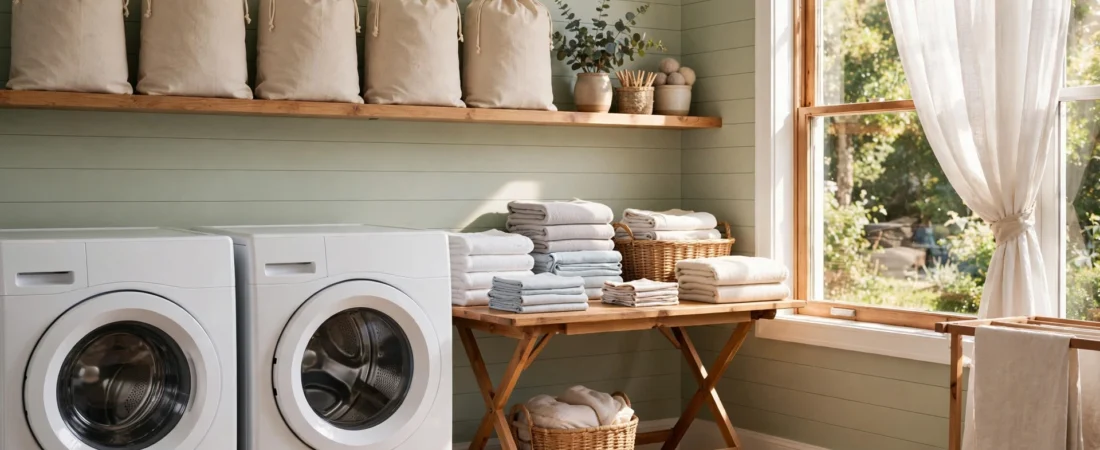
Many successful home laundry pros run the whole operation out of a laundry room and a folding table. The polish comes from the process, not the square footage.
Step 5: Choose your business model — your brand or a gig app
This is the decision that determines how much you keep.
Option A: Gig platforms (Poplin, Hampr, Laundry Care). These apps connect you with customers, handle payments, and send you orders. The trade-off: they take a cut. Poplin pays providers starting around $0.75 per pound for standard service (per a 2026 guide at climbtheladder.com), Hampr pays 70% of the market rate per load, and Laundry Care pays a flat $20 per bag with reported weekly averages of $120–$300. You build someone else’s brand, and your rates are their rates.
Option B: Your own business. You set your prices, you keep the revenue, and the customers are yours — they book you, not an app. The trade-off: you handle your own marketing and booking. This is where a platform like LaundryCareer changes the math: you get your own branded booking page (customers never see our platform), Stripe payments handled at pickup, instant booking alerts, and you keep 100% of every order. The platform costs $29.99/month flat. No commission, ever.
There’s no wrong answer, and many pros start with a gig app to learn the ropes, then migrate their customers to their own brand where they keep everything. The point is to understand what each percentage point costs you before you commit.
Step 6: Get your first customers
Your first 10 customers almost always come from the same places:
- Facebook groups and Nextdoor. Post in neighborhood and mom groups with clear pricing and photos of your work. Consistent, helpful posting beats one splashy ad.
- Word of mouth. Tell everyone. Offer a first-order discount or a referral reward and say it out loud at pickup.
- Flyers with a QR code. A simple flyer on community boards — “Wash & Fold, Free Pickup, scan to book” — still works, and a QR code that opens your booking page turns a glance into an order.
- Your booking link, everywhere. Put it in your Facebook profile, your Nextdoor bio, and every post you make. Every impression should end somewhere a customer can book.
When someone books, the experience has to feel professional: instant confirmation, pickup on time, laundry back folded and on schedule. Your first customers become your reviews, and your reviews become your next customers.
Step 7: Deliver, review, repeat
The weekly rhythm of a home laundry business:
- Book. Orders land on your page; you get an alert instantly.
- Pick up. Meet the customer or grab the bag from the porch at the scheduled time.
- Process. Sort, wash, dry, fold — with the preferences each customer told you (water temp, detergent, softener).
- Return. Deliver folded and bagged, collect payment, and ask for a review.
Reviews are your growth engine. Both sides reviewing each other builds trust, and the stars on your booking page do your selling for you.
How LaundryCareer fits in
If you go the own-brand route, LaundryCareer is the infrastructure: your branded booking page with your name, logo, and prices; payments handled securely through Stripe (card charged at pickup, never before); instant booking alerts so you never miss an order; discount codes, a customer list, and QR-code flyers built in. It costs $29.99 a month — your only platform cost — and you keep 100% of every order after the Stripe card fee. No staged success stories, no commission math to untangle.
FAQ
How much does it cost to start a laundry business from home?
If you already own a washer and dryer, your startup cost is supplies and a platform subscription — well under $100 plus your first month of LaundryCareer at $29.99.
Do I need a license to do laundry from home?
Requirements vary by city and county. Many home-based laundry services need only a business name registration. Check your local rules before taking orders.
How much can I make?
It depends on your prices, order volume, and how much time you put in. At $1.79 per pound, a 20-pound order is $35.80 before costs. No honest guide will promise you a specific income — the math is yours to run.
Can I run this around a day job?
Yes. Evenings and weekends are when pickup and delivery windows naturally fall, and folding happens on your schedule.
Ready to turn your washer and dryer into a business? Your booking page, payments, and customer tools are one signup away.