
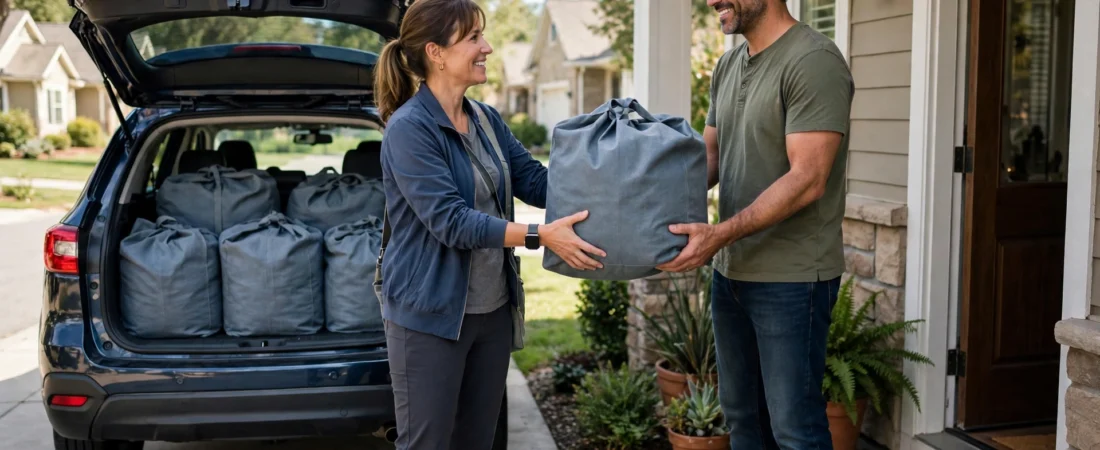
There are two kinds of laundry businesses: laundromats (big machines, big lease, big capital) and laundry services (you, a washer and dryer, pickup and delivery). This guide is about the second kind — the one you can start this week.
Below is the exact sequence: every step from idea to your first paid pickup, in order, with nothing skipped.
Step 1: Pick your service model
The most common home laundry service models:
- Wash and fold. The bread and butter: per-pound pricing ($1.00–$2.50/lb), 15–30 pound typical loads.
- Wash and fold + pickup and delivery. Same thing, with a $10–$15 delivery fee or a baked-in rate. This is what most customers actually want.
- Specialty services. Ironing ($2–$3 per item), dry cleaning courier, comforters and bulky items ($15–$40 each), commercial laundry for Airbnbs and small businesses.
Start with wash and fold plus pickup and delivery. Add the rest when customers ask — they will.
Step 2: Set your prices
Don’t guess. The market has already decided:
- Wash & fold: $1.00–$2.50 per pound (suggested default: $1.79/lb)
- Minimum order: $15–$25
- Express turnaround: 30–40% premium
- Ironing: $2–$3 per item
- Comforters/bulky items: flat $15–$40 each
Calculate your cost per pound (supplies, water, energy, your time) and make sure your price leaves margin. Then write the price sheet down and put it on your booking page — posted prices end haggling before it starts.
Step 3: Give it a name and a brand
Your brand is the difference between “someone who does laundry” and a business. Pick a name that’s easy to remember and say out loud, design a simple logo (a shirt or a basket icon works), and pick two colors. That’s your entire visual identity — consistency matters more than creativity.
Your brand shows up in three places: your booking page (your name, your logo, your colors — customers should never see a platform’s branding), your flyers and social posts, and your packaging. Folded laundry in a clean, tagged bag with your name on it is a billboard.
Step 4: Set up your booking system
This is the step that separates amateurs from businesses. Customers should be able to book you in two minutes from their phone — see your services and prices, pick a pickup time, save their card. No texting back and forth, no phone tag.
This is exactly what LaundryCareer builds for you: a branded booking page where customers sign up, log in, and book; secure card-on-file through Stripe (charged at pickup, never before); instant booking alerts so you know the second an order comes in; your schedule and pause controls; and reviews that post to your page. One flat $29.99/month, 0% commission, 100% of every order after the card fee.
Test your own booking page like a customer before you share it anywhere. If booking feels clunky to you, it will lose customers.
Step 5: Handle payments properly
Cash and “just Venmo me” don’t scale and don’t look professional. Set up card payments from day one:
- Card on file at booking, charged when you mark the order picked up.
- Clear refund/exception policy (rewash a bad load, don’t argue about it).
- Payouts to your bank on a schedule you can explain to an accountant.
Stripe-backed payments with automatic charging at pickup mean you never chase money. Payment friction kills repeat business faster than a bad fold.
Step 6: Cover the legal basics
Register your business name (usually a DBA or assumed-name certificate at the county clerk), check your city and county for any home-business licensing requirements, and keep business money in a separate bank account from day one. If revenue grows, a tax professional’s hour is the cheapest money you’ll spend. This isn’t legal advice — check your local rules — but for most home laundry services, the paperwork is a morning’s work, not a month’s.
Step 7: Launch and get your first 10 customers
Week one marketing, in order of effectiveness:
- Post in local Facebook groups and Nextdoor with clear prices and photos of your work. Post more than once.
- Activate your network — friends, family, coworkers, school and church groups.
- Flyers with QR codes on community boards, with the QR opening your booking page directly.
- A first-order offer — a small discount or free pickup — to get people to try you once.
Every one of these should end with your booking link. The goal of week one isn’t profit; it’s ten customers who can leave reviews.
Step 8: Nail the order flow
Your reputation is built one order at a time. The flow:
- Book — order lands on your dashboard with an instant alert.
- Confirm — the customer gets confirmation automatically. No phone tag.
- Pick up — on time, at the scheduled window. The card is charged when you mark it picked up.
- Process — sort, tag, wash, dry, fold to the customer’s stated preferences.
- Return — folded, bagged, on schedule. Ask for a review.
Mix-ups are the one unforgivable sin. Tag every bag with the customer name and order date, and never let two customers’ laundry share a machine unsorted.
Step 9: Turn customers into regulars
One-time customers pay bills; weekly regulars build businesses. The levers:
- Recurring pickup slots — “every Tuesday” beats “call me when you need it.”
- Standing-customer perks — a small discount code or priority express windows for regulars.
- Reviews on your page — social proof that sells the next customer while you sleep.
- Referral rewards — a discount for the referrer and the friend. Word of mouth is your cheapest acquisition channel.
Track who your regulars are (a customer list with order history does this automatically on LaundryCareer) and notice when one goes quiet — a quick “haven’t seen you in a few weeks” message wins back more business than any ad.
Step 10: Grow on purpose
When you’re consistently full, you have options: raise prices (demand justifies it), add a second washer/dryer set, hire pickup help, or take on commercial accounts (Airbnb hosts, gyms, salons — priced from $1.49/lb on LaundryCareer). Set a weekly capacity and stop booking past it. Running a waiting list looks like success because it is success.
FAQ
How long does it take to start?
The practical answer: you can take your first booking within days of setting up your page. The business-name registration and brand setup are a weekend’s work.
How much money do I need to start?
If you own the equipment, under $100 for supplies plus a $29.99/month platform subscription. This is one of the cheapest real businesses to start.
Should I quit my job?
No. Start evenings and weekends, build to steady recurring revenue, and let the numbers make that decision for you.
The fastest way to start is to make booking you effortless. Your branded page, payments, and customer tools are ready when you are.