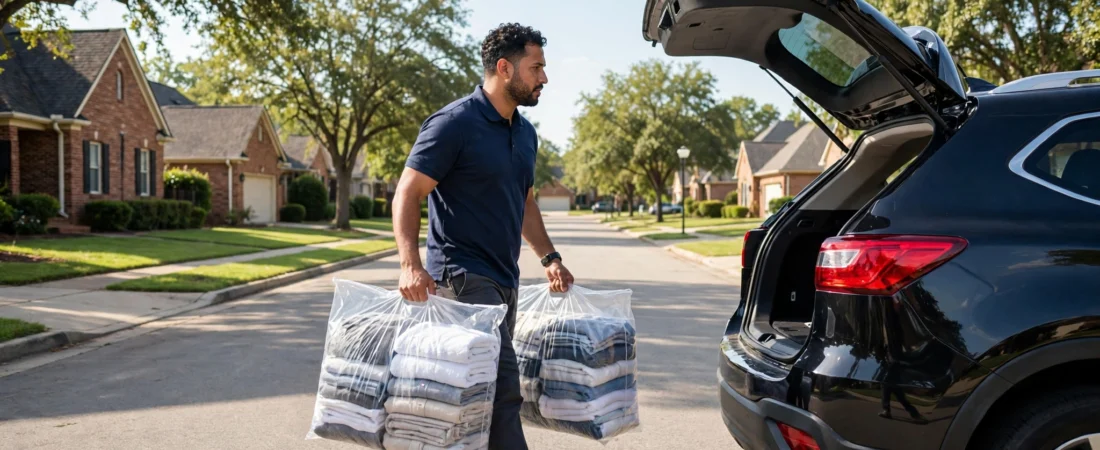
How to Start a Laundry Business in Dallas, Texas (2026)
Dallas is a top-10 U.S. city — 1,304,379 people in the 2020 Census — sitting inside the Dallas–Fort Worth metroplex, one of the largest metro areas in the country. For a home laundry pro, that means something better than a big city: a dense one, where a single pickup route can serve dozens of households. And Texas keeps the paperwork light. Here’s the accurate launch path.
Disclaimer: general information, not legal advice. Confirm your specifics on the official state sites linked below.
Why Dallas works for a home laundry business
- Two cities, one market. Dallas (1.3M) and Fort Worth (918,915 in the 2020 Census) anchor a metroplex of suburbs — Plano, Irving, Arlington, Garland, Frisco — packed with exactly the households that buy wash and fold: busy professionals, dual-income families, and apartment renters.
- Pickup and delivery fits the sprawl. DFW customers already get everything delivered. A laundry service that comes to the door beats a laundromat trip across town, every time.
- Start tiny, stay full. You don’t need “Dallas.” One suburb’s worth of repeat weekly households — 20 to 30 — is a full book for a home pro.
Step 1: Handle the Texas paperwork (it’s light)
No general license. Texas does not require a general business license, and the state’s no-impact home business law says a city may not require a license or permit for a home business with no neighborhood impact — no customer traffic, no signage, no noise. A pickup-and-delivery laundry service fits cleanly. Dallas home-based businesses should still do a quick check of the city’s current home-occupation rules, and HOA rules are separate from city law — read yours if you have one. Background: do you need a license for a home laundry business in Texas?
Get a sales tax permit — this one is not optional. The Texas Comptroller lists “laundry, cleaning and garment services” as taxable services (Publication 96-259), so a Dallas wash-and-fold pro needs a Texas sales and use tax permit. It’s free from the Comptroller; you collect and remit sales tax on your services. Start at the state’s official portal: Texas.gov — Starting a Business in Texas.
Pick your business structure:
- DBA: using a business name? File an assumed-name certificate with your county clerk (Dallas County for most Dallas pros) — typically $15–$50. Enough to start.
- LLC: a Texas LLC costs a $300 state filing fee (Certificate of Formation, filed with the Secretary of State) and legally separates the business from you personally. Many pros form it once revenue is steady — not required on day one.
- EIN: free from the IRS in about 10 minutes; useful for a business bank account even as a sole proprietor.
Step 2: Set up your home operation
Your existing washer and dryer are the launch equipment. Add a hanging scale (you’ll price by the pound), detergent options including unscented, clear bags, labels, and a clean folding surface. Most home pros launch for a few hundred dollars — the full math is in our wash and fold startup costs breakdown. Protect the business with a general liability policy (typically $300–$600/year) so a damaged garment is an insurance claim, not a personal bill.
Step 3: Price it right — and think in routes
Wash and fold is priced per pound. Typical wash-and-fold prices in Texas metros commonly run about $1.50–$2.50 per pound with pickup and delivery (a typical range, not a Dallas statistic — check local laundromat prices and land in that band). The DFW edge is route density: schedule pickup days by area (say, North Dallas on Tuesdays, the mid-cities on Thursdays) so one drive collects ten orders instead of two. Ten 20-pound orders at $2.00/lb is $400 of revenue on a single route.
Step 4: Get customers — without giving away a cut of every order
Gig apps bring orders and keep a percentage of every one, permanently. Owning your booking page flips that. LaundryCareer gives Dallas pros a branded booking page with online booking, card payments, and pickup scheduling for a free-to-join page — live the day you sign up; you pick your plan when you activate: Plus $8/month plus 4% when you get paid, or Unlimited $20/month with 0% (Stripe’s standard card fee still applies). Joining is free and nothing is charged when you sign up — your plan starts only when you activate it. On $1,600/month of orders, a 30% commission app keeps about $480 of your money. LaundryCareer keeps just $8 or $20 a month — and only once you activate. That’s the whole pitch.
What the first month realistically looks like
Week 1: paperwork (an afternoon), supplies, booking page live. Pick your first route area — one suburb or neighborhood cluster, not the whole metroplex. Week 2: first orders, mostly from your own network and neighborhood groups. Deliver perfectly; early customers are your review engine. Weeks 3–4: repeats begin (laundry returns weekly — that’s the business), referrals follow, and you add a second route day.
An honest illustration, not a promise: five regular households ordering 20 pounds a week at $2.00/lb is about $800/month in revenue against your monthly platform fee and modest supply costs. Fifteen regulars is roughly $2,400/month — and in DFW, fifteen households can sit inside two apartment communities on one route. Your numbers depend on your prices, routes, and retention, which is why the pros who win here treat route reliability like a religion.
Three free moves that fill a Dallas route: a free Google Business Profile so “wash and fold near me” finds you, posts in neighborhood and apartment-community groups announcing your route days, and a referral offer — a free load for every neighbor a customer sends you. Just our 4% when you get paid.
Quick answers for Dallas pros
Do I need a license to do laundry from home in Dallas? No general license — Texas doesn’t issue one, and the state’s no-impact home business law covers quiet pickup-and-delivery operations. You do need the free Texas sales tax permit (laundry services are taxable in Texas) and a DBA if you use a business name. Do a quick check of Dallas’s current home-occupation rules as well.
Do I have to form an LLC before my first order? No. Many Dallas pros start as sole proprietors with a DBA and form the LLC ($300 state fee) once weekly revenue is steady.
Can I serve Fort Worth too? Yes — your Texas paperwork is state-level, not city-level. Many DFW pros run Dallas routes and Fort Worth routes on different days under the same business and booking page.
The Dallas launch checklist
- ☐ Quick check of Dallas home-occupation rules + your HOA (if any)
- ☐ Get your free Texas sales tax permit from the Comptroller
- ☐ File a DBA with your county clerk if using a business name ($15–$50)
- ☐ Get a free EIN from the IRS
- ☐ Form an LLC when revenue justifies it ($300 Texas filing fee)
- ☐ Add general liability insurance (typically $300–$600/year)
- ☐ Set your per-pound price (typical Texas range: $1.50–$2.50/lb) and your route days
- ☐ Launch your booking page and share the link with your first 10 households
Keep exploring: starting a laundry business in Dallas.
DFW rewards the pro who shows up reliably on the same route days, week after week. Paperwork in an afternoon, first route this weekend — see the plan pricing or create your pro account and launch your Dallas booking page.
Starting a laundry business in Texas
This guide is one city in a bigger picture. The Texas state hub collects the state rules — sales tax, LLC fees, where to file — and every city guide in the state.