How to Start a Laundry Business in Los Angeles, California (2026)
Los Angeles is the second-biggest city in the United States — 3,898,747 people in the 2020 Census — and one of the best wash-and-fold markets in the country: millions of renters and apartment laundry rooms nobody loves. California’s paperwork has one big piece of good news (no sales tax on your service) and one honest catch (the LLC’s $800 annual franchise tax). Here is the exact, accurate path from “I have a washer” to “I’m taking paid orders.”
Disclaimer: general information, not legal advice. Confirm your specifics on the official state sites linked below.
Why Los Angeles works for a home laundry business
- Scale. Nearly 3.9 million people inside the city limits. A home pro doesn’t need “Los Angeles”; a few neighborhoods’ worth of repeat households is a full book.
- Renters everywhere. LA is a city of apartment living, where in-unit laundry is a luxury and shared laundry rooms are a chore. Pickup and delivery removes the whole chore — that’s what your customers are buying.
- Time is the local currency. Production crews, healthcare and hospitality shift workers, dual-income families — LA runs on people who will gladly pay to never think about laundry again.
Step 1: Handle the California paperwork (different from most states)
No sales tax on your service — California is clear on this. Under Revenue and Taxation Code § 6018.6, a garment cleaner is treated as a consumer of the supplies it uses, not a retailer — so your wash-and-fold service charges are not subject to sales tax, per the CDTFA’s own guidance. Sales tax only enters the picture if you sell goods on the side. You pay tax on the supplies you buy; you don’t collect it on your service.
Check your city business license. California has no single state-level general license, but cities run their own licensing (often called a business tax certificate), and home-occupation rules are local too. Check the City of Los Angeles’s current requirements for a home-based business before your first order, and check your HOA or lease rules too.
Pick your business structure:
- DBA: operating under a business name? File a Fictitious Business Name statement with the Los Angeles County Clerk. Enough to start.
- LLC: a California LLC costs a $70 state filing fee (Articles of Organization, Form LLC-1, filed online through the Secretary of State’s bizfile system) — but know the full picture: California LLCs also file a $20 Statement of Information and owe the state’s $800 annual franchise tax. That’s why many LA pros start as sole proprietors and form the LLC once revenue comfortably covers it. Start at the state’s official portal: California Secretary of State — Business Programs.
- EIN: free from the IRS in about 10 minutes; get one for your business bank account even as a sole proprietor.
Step 2: Set up your home operation
You likely own the core equipment already. The typical home-pro setup: your washer/dryer (a second set comes later, from revenue), a hanging scale, unscented + regular detergent options, clear bags, labels, and a folding surface. Real numbers in our wash and fold startup costs breakdown — most home pros launch for a few hundred dollars, not thousands. Add a general liability policy (typically $300–$600/year) so one damaged garment isn’t your problem to pay out of pocket.
Step 3: Price it right — and think in zones
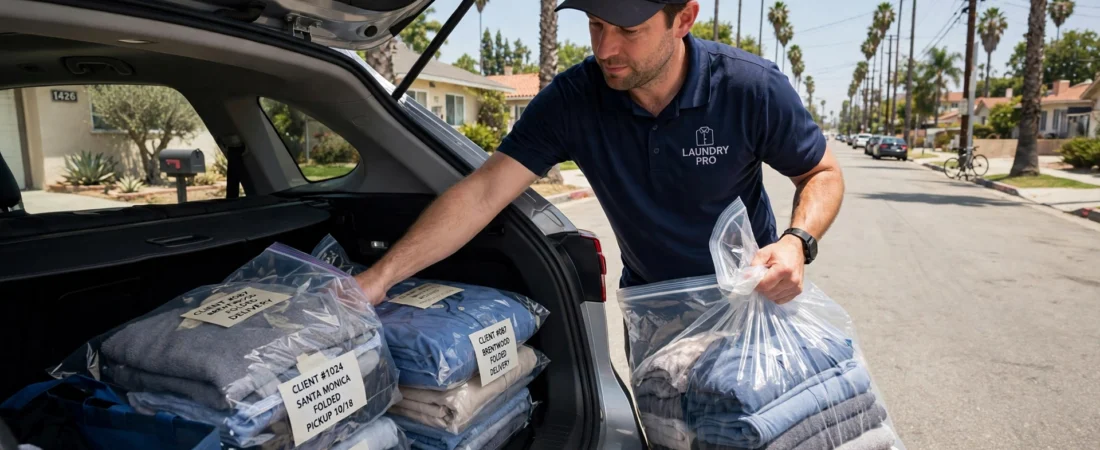
Wash and fold is usually priced per pound. Typical wash-and-fold prices commonly run about $1.50–$2.50 per pound with pickup and delivery (a typical range, not a Los Angeles statistic — check what local laundromats charge and price in that band). A 20-pound order at $2.00/lb is a $40 ticket; ten of those a week is $400/week from a spare-room operation. In LA, the real skill is zoning: pick one cluster of neighborhoods per route day instead of crossing the city for single orders — that’s the whole pickup and delivery business model working for you. Same-day service, hypoallergenic detergent, and careful folding are the add-ons LA customers happily pay extra for.
Step 4: Get customers — without giving away a cut of every order
Gig apps will send you orders — and keep a slice of every single one, forever. The alternative: your own booking page. LaundryCareer gives Los Angeles pros a branded booking page with online booking, card payments, and pickup scheduling for a free-to-join page — live the day you sign up; you pick your plan when you activate: Plus $8/month plus 4% when you get paid, or Unlimited $20/month with 0% (Stripe’s standard card fee still applies). Joining is free and nothing is charged when you sign up — your plan starts only when you activate it. Do the math: on $1,600/month of orders, a 30% commission app keeps roughly $480 of your money. LaundryCareer keeps just $8 or $20 a month — and only once you activate. That gap is your profit.
What the first month realistically looks like
Week 1: paperwork (an afternoon), supplies, and your booking page live. Choose your first zone — one neighborhood cluster, not the whole city — and tell everyone you know there: first orders almost always come from your own circle. Week 2: your first handful of orders. Wash, fold, and deliver like it’s a five-star hotel — early customers are your review engine. Weeks 3–4: repeat orders start (laundry comes back every week — that’s the beauty of this business), plus referrals from the first happy households.
An honest illustration, not a promise: five regular households ordering 20 pounds a week at $2.00/lb is about $800/month in revenue against your monthly platform fee and modest supply costs. Fifteen regulars is roughly $2,400/month — from equipment you already own, on a schedule you set. Your numbers depend on your prices, your routes, and how well you keep customers, which is why most successful pros obsess over folding quality and on-time delivery, not advertising.
Three free moves that fill an LA route: a free Google Business Profile (so “laundry service near me” finds you), posts in neighborhood groups and Nextdoor offering a first-order route in your zone, and a simple referral offer — existing customers earn a free load for every neighbor who books. None of it costs a commission.
Quick answers for Los Angeles pros
Do I charge sales tax on wash and fold in California? No. Under Revenue and Taxation Code § 6018.6, you’re treated as a consumer of your supplies, not a retailer — your service charges aren’t taxed. (If you sell products, those sales are a different story.)
Do I have to form an LLC before my first order? No. Many LA pros start as sole proprietors with a DBA and form the LLC later — sensible in California, where the LLC carries an $800 annual franchise tax on top of the $70 filing fee.
How do customers pay me? Through your booking page — card payments are built in, and you get paid on every order through LaundryCareer — you pick Plus ($8/month plus 4% when you get paid) or Unlimited ($20/month with 0%) when you activate (Stripe’s standard card fee applies). No chasing cash or checks.
The Los Angeles launch checklist
- ☐ Check the City of LA’s business license and home-occupation requirements (+ HOA/lease rules)
- ☐ File a Fictitious Business Name statement with LA County if using a business name
- ☐ Get a free EIN from the IRS
- ☐ Form an LLC when revenue justifies it ($70 filing + $20 Statement of Information + $800/year franchise tax)
- ☐ Add general liability insurance (typically $300–$600/year)
- ☐ Set your per-pound price (typical range: $1.50–$2.50/lb) and your route zones
- ☐ Launch your booking page and share the link with your first 10 households
Keep exploring: starting a laundry business in Los Angeles.
LA is too big to serve all of it — and that’s the point: one zone of loyal weekly households is a real business. Paperwork handled in an afternoon, customers on your own page by the weekend — see the plan pricing or create your pro account and launch your Los Angeles booking page.
Starting a laundry business in California
This guide is one city in a bigger picture. The California state hub collects the state rules — sales tax, LLC fees, where to file — and every city guide in the state.