
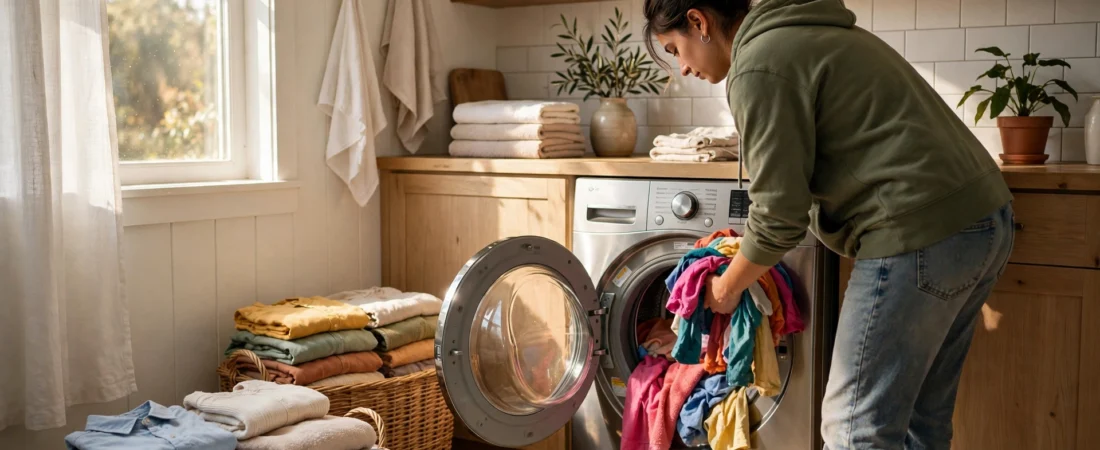
Every side hustle has a catch. Driving means miles on your car. Delivery means tips that don’t cover gas. Freelancing means competing with the whole internet. The laundry side hustle has a different profile: the equipment is already in your home, the work fits around anything, and the demand is as permanent as dirty socks.
Here’s what it actually takes to start, what the realistic numbers look like, and how to keep this side hustle from quietly becoming a job that pays less than your real one.
Why laundry works as a side hustle
Four things make laundry unusual among side hustles:
- Near-zero startup cost. Washer, dryer, vehicle — you probably own all three. Supplies for your first customers cost less than one grocery run.
- Flexible hours. Folding happens whenever. Pickups and deliveries slot into evenings and weekends — exactly when customers are home anyway.
- Recurring revenue. Laundry doesn’t end. A weekly customer is a weekly paycheck, and five steady customers are a foundation.
- Skills you already have. You’re not learning to code or getting a certification. You’re doing laundry the way you do it now, just for someone paying you.
What you actually need
Not much:
- A washer and dryer in working order (a second machine helps later, not now).
- A vehicle for pickup and delivery.
- Detergent, softener, and a fragrance-free option for sensitive customers — people with allergies will pay a premium for the option.
- Clear plastic bags or garment bags for returns.
- A folding surface and a system for tagging each customer’s order.
That’s the equipment list. The real requirement is reliability: pickup when you said, return when you promised, folded the way they like.
Two paths: gig apps vs. your own brand
Path 1: Gig platforms. Apps like Poplin, Hampr, and Laundry Care hand you customers and handle payments. Poplin pays providers starting around $0.75 per pound for standard service; Hampr pays 70% of the market rate per load; Laundry Care pays a flat $20 per bag. It’s the fastest way to your first paid load, and there’s real value in learning the business on someone else’s dime. The ceiling is their rates and their rules.
Path 2: Your own brand. You set the prices (the industry range is $1.00–$2.50 per pound), you own the customers, and you keep the full ticket. The trade-off is you do your own marketing — posting in Facebook groups, Nextdoor, flyers with a QR code to your booking page. A platform like LaundryCareer removes the hard part of this path: your branded booking page, Stripe payments at pickup, instant booking alerts, discount codes, and a customer list, for $29.99/month flat with 0% commission. After the card fee, every dollar is yours.
Many people start on Path 1 and migrate to Path 2 once they’ve got the skills and confidence. Know both options and choose on purpose.
The first-customers playbook
Your first customers are almost always nearby and almost always found the same way:
- Post in neighborhood Facebook groups and on Nextdoor. Introduce yourself, state your prices clearly, show photos of folded laundry. Post consistently — one post won’t do it; steady, helpful presence does.
- Tell your actual network. Friends, family, coworkers, church, school groups. Say the words out loud: “I’m doing wash and fold with free pickup.”
- Offer a first-order hook. A small discount or a free pickup on the first order gets people to try you. The quality of the fold brings them back.
- Leave a trail. Every post, flyer, and profile should end with your booking link or a QR code that opens it. Attention you can’t convert is just noise.
Your first five customers will teach you everything: which prices stick, which neighborhoods order, what upcharges people actually buy. Listen to them.
Scheduling it around a life
This is where laundry beats most side hustles. The work splits naturally:
- Active time: pickup, drop-off, and any ironing or special handling. Batch pickups by neighborhood so one drive covers several customers.
- Passive time: the machines run themselves. Fold in the evening while you’re already home.
A weekly rhythm might look like: pickup windows Tuesday and Friday evenings, returns Thursday and Sunday, folding whenever the TV is on. No boss, no commute, no fixed shift — but also no one else to blame if the system slips. Set pickup windows and keep them.
A sample first month
Here’s what getting started actually looks like, week by week:
- Week 1: Setup. Name and brand, booking page live, price sheet posted, first posts in Facebook groups and Nextdoor, flyers printed. Goal: everything a customer needs to book you exists.
- Week 2: First customers. Keep posting. Tell your network directly — not a broadcast, individual messages to people who might know someone. Goal: first 3 orders.
- Week 3: Delivery and reviews. Nail every order. Ask each customer for a review after a successful delivery. Goal: first reviews on your page.
- Week 4: Systematize. Lock in pickup windows, standardize your tagging and bagging, set your weekly capacity. Goal: a rhythm you can repeat.
Nobody’s first month is smooth. Machines break, a pickup runs late, a stain won’t come out. The pros who make it aren’t the ones who avoid problems — they’re the ones who communicate: text the customer before they’re wondering, rewash the load without being asked, and keep the standard high when it’s inconvenient.
When to raise your prices
Raise prices when: you’re consistently at capacity (demand exceeds supply — that’s the market telling you you’re underpriced), your costs move up meaningfully, or you’ve added services that justify it (express windows, premium detergent options). Raise in small steps — 5–10% — announce it to regulars before it hits, and grandfather existing weekly customers for a month as a loyalty gesture. Customers accept fair increases from pros they trust; they punish surprise ones.
Realistic expectations (the honest version)
No side hustle guide should promise you a number, and this one won’t. What the math depends on: your price per pound, your average order size (typical loads run 15–30 pounds), how many regulars you land, and how much time you put in.
An illustrative example to show the shape of it: at $1.79 per pound, five weekly customers averaging 20 pounds each is $1,790 per month in revenue before costs. Your costs are supplies, utilities, fuel, and platform fees — on your own brand, that platform fee is a flat $29.99/month and the commission is zero. Run the same math at whatever price and customer count you actually have, and you’ll know exactly what this hustle pays you.
The honest risks: laundry is physical work, machines wear faster, and peak weeks (holidays, move-in season) can swamp you. Set a weekly capacity and stop accepting orders when you hit it — scarcity makes you look professional, not unavailable.
Upsells that actually work
Once the core is running, the margins live in the add-ons:
- Ironing at $2–$3 per garment — high margin, customers who want it really want it.
- Express turnaround at a 30–40% premium for same-day or next-day.
- Bulky items — comforters and sleeping bags at $15–$40 flat each.
- Commercial accounts — Airbnb hosts, small gyms, salons. One commercial customer can equal five residential ones, and LaundryCareer pros price commercial wash and fold starting at $1.49 per pound.
From side hustle to business
The fork in the road comes when you’re full. You can raise prices, add a second machine, or bring in help for pickups. Some people stay happily at five regulars forever. Others build out. Either way, the infrastructure that lets you grow — online booking, payments, reviews, customer records — is the same infrastructure that makes the side hustle pleasant in the first place.
Your washer and dryer are already earning you nothing. Change that.